








Rewriting the RFS Playbook: The Coming Battle over the 2027 Biomass-Based Diesel RVOs
The battle over the 2027 Renewable Fuel Standard (RFS) volumes has begun. Earlier this week, Louisiana Governor Jeff Landry and Alabama Governor Kay Ivey asked EPA Administrator Lee Zeldin for a partial waiver of the 2027 RFS requirements. They call the request “targeted, prospective and temporary.” Governor Landry has urged the governors of Texas, Mississippi, and Arkansas to join them. Biofuel and farm groups quickly urged EPA to reject the petitions. More petitions are likely, and so is a long fight. This article shows what is at stake.
Previously (farmdoc daily, May 11, 2026), we examined the challenge of meeting D4 biomass-based diesel RIN generation under the final RFS volumes for 2026 and 2027. Our balance sheet at that time showed that required D4 net RIN generation had to rise from 7.10 billion RIN gallons in 2025 to 10.99 billion in 2026 and 11.89 billion in 2027. The required monthly pace was 916 million RIN gallons in 2026 and 991 million in 2027. Actual generation in early 2026 was running far below that pace.
A lot has changed since May. EPA granted a large batch of small refinery exemptions (SREs) for 2024 and 2025. It then proposed reallocating the additional exempted 2025 volume to 2026 and 2027. Gasoline and diesel use tracks below EPA’s projections for 2026 at present. Ethanol RIN generation has recovered. Monthly D4 RIN generation also picked up over the spring and summer. The purpose of this article is to update our D4/D5 RIN balance sheet after these developments. We then revisit the monthly pace of D4 RIN generation needed in 2026 and 2027. We close by drawing out the implications for the coming battle over the 2027 volumes.
Analysis
Our framework is the same balance sheet identity used in our earlier articles (farmdoc daily, April 27, 2026; May 11, 2026; June 10, 2026):
Beginning RIN Bank + RIN Generation + Current Year Deficit − RVOs − Exports − Previous Year Deficit − Ending RIN Bank = 0
The updated D4/D5 balance sheet is shown in Table 1. Values for 2024 and 2025 now reflect the SRE decisions EPA released in August. Required D4 net RIN generation is now 8.82 billion RIN gallons in 2026 and 11.55 billion in 2027. That is 2.17 billion lower than our May projection for 2026 and 0.34 billion lower for 2027. Even so, required generation is still 24 percent above the 2025 level in 2026 and 63 percent above it in 2027. Six factors drove the revisions and we review each in turn. Some lowered required generation while others raised it.
Table 1. Updated Projection of D4 + D5 Biomass-Based Diesel RIN Balance Sheets for 2023 – 2027
| Calendar Year | |||||
| Balance Sheet Category (billion RIN gallons) | 2023 | 2024 | 2025 | 2026 | 2027 |
| Supply | |||||
| Beginning D4 + D5 Bank | 0.25 | 1.20 | 2.61 | 1.89 | 0.18 |
| D4 Gross RIN Generation | 7.97 | 9.18 | 7.13 | 8.85 | 11.58 |
| D4 Errors and Corrections | 0.02 | 0.03 | 0.01 | 0.01 | 0.01 |
| D4 Other Use | 0.13 | 0.06 | 0.01 | 0.01 | 0.01 |
| D4 Net RIN Generation | 7.82 | 9.10 | 7.10 | 8.82 | 11.55 |
| D5 Gross RIN Generation | 0.26 | 0.24 | 0.28 | 0.17 | 0.17 |
| D5 Errors and Corrections | 0.00 | 0.00 | 0.00 | 0.00 | 0.00 |
| D5 Other Use | 0.00 | 0.00 | 0.01 | 0.01 | 0.01 |
| D5 Net RIN Generation | 0.26 | 0.24 | 0.27 | 0.16 | 0.16 |
| Total D4 + D5 Supply | 8.33 | 10.54 | 9.98 | 10.88 | 11.90 |
| Demand | |||||
| D4 RVO | 4.47 | 4.79 | 5.24 | 8.92 | 9.19 |
| D4 Export Retirements | 0.80 | 1.05 | 1.07 | 0.83 | 0.60 |
| D4 Prior Year Deficit | 0.10 | 0.11 | 0.03 | 0.03 | 0.28 |
| D4 Current Year Deficit | 0.11 | 0.03 | 0.03 | 0.28 | 0.28 |
| D4 Total Demand | 5.26 | 5.91 | 6.31 | 9.51 | 9.78 |
| D5 RVO | 0.57 | 0.77 | 1.03 | 0.69 | 0.72 |
| D5 Export Retirements | 0.05 | 0.05 | 0.06 | 0.03 | 0.03 |
| D5 Prior Year Deficit | 0.03 | 0.00 | 0.00 | 0.00 | 0.00 |
| D5 Current Year Deficit | 0.00 | 0.00 | 0.00 | 0.00 | 0.00 |
| D5 Total Demand | 0.64 | 0.82 | 1.09 | 0.72 | 0.75 |
| D6 Demand | 1.22 | 1.20 | 0.69 | 0.47 | 1.18 |
| Total D4 + D5 + D6 Demand | 7.13 | 7.93 | 8.09 | 10.70 | 11.71 |
| Ending Bank | 1.20 | 2.61 | 1.89 | 0.18 | 0.18 |
Note: 2023–2025 are actual values based on EPA data, except that deficits carried out of 2024 and 2025 are estimates. 2024 and 2025 reflect the SRE decisions released in August 2026. 2026 and 2027 are projections and include EPA’s proposed reallocation of additional exempted 2025 volume, split equally between the two years. Deficits carried out of 2026 and 2027 are set at their five-year averages: 3.1 percent of the biomass-based diesel RVO for D4 and 2.3 percent of the conventional RVO for D6.
- Gasoline and diesel use. The RFS standards are set as percentages of obligated petroleum gasoline and diesel use. EPA converts the percentages to volumes using its own projection of fuel use. When actual fuel use comes in lower, the volume obligations fall too. The final Set 2 rule assumed total petroleum gasoline and diesel use of 180.6 billion gallons in 2026 and 178.8 billion gallons in 2027. Based on EIA’s October Short-Term Energy Outlook, we now project 176.2 billion gallons in 2026 and 176.9 billion gallons in 2027. That is 4.4 billion gallons below EPA in 2026 and 1.9 billion gallons below in 2027. By itself, lower fuel use cuts the biomass-based diesel RVO by about 0.24 billion RIN gallons in 2026 and 0.10 billion in 2027. It also trims the conventional RVO. This factor lowers required D4 generation, but only modestly.
- D6 ethanol RIN generation. The D6 ethanol balance sheet matters a great deal for the D4 market. When D6 RINs fall short of the conventional obligation, obligated parties use D4 RINs to fill the gap. We call this the D6 “pull.” In May, we assumed D6 RIN generation would stay at the 2025 level of 14.66 billion. We now project 14.85 billion in both 2026 and 2027. That is in line with 2023 and 2024. Each additional D6 RIN reduces the D6 pull one-for-one. We also lowered projected D6 export retirements from 0.66 to 0.55 billion. Together with the RIN bank and deficit changes discussed below, the D6 pull falls from 1.42 to 0.47 billion RIN gallons in 2026 and from 1.41 to 1.18 billion in 2027. This is one of the two largest sources of the downward revision for 2026.
- D4 export retirements. RINs must be retired when biomass-based diesel is exported. In May, we assumed D4 export retirements of 0.53 billion RIN gallons in both 2026 and 2027. Export retirements have declined more slowly than we expected. They were 1.07 billion in 2025. We now project 0.83 billion in 2026 and 0.60 billion in 2027. This raises required D4 generation by 0.30 billion in 2026 and 0.07 billion in 2027.
- Small refinery exemptions. EPA released two major SRE decisions in August. The August 3 decision raised total exempted gasoline and diesel volume for 2024 from 7.78 to 9.18 billion gallons. The August 31 decision put exempted volume for 2025 at 13.38 billion gallons. The final Set 2 rule had projected only 7.55 billion. Without reallocation, these exemptions are simply lost mandated volume. For example, the 2024 and 2025 decisions cut the 2025 biomass-based diesel RVO from 5.42 to 5.24 billion RIN gallons and the 2025 D6 pull from 1.20 to 0.69 billion. RINs that would have been retired stayed in the bank instead. The large jump in 2025 exemptions over EPA’s projection drew strong pushback from the agricultural and biofuel industry. EPA responded on August 31 with a pledge to reallocate 100 percent of the difference between projected and actual 2025 exemptions. It followed through with a supplemental proposal on October 13. In RIN terms, EPA exempted 1.76 billion RINs of 2025 obligations, compared with the 0.99 billion it projected in the Set 2 rule. The proposal would reallocate the 0.77 billion RIN difference. Of that total, 0.18 billion RINs is biomass-based diesel, 0.07 billion is other advanced biofuel, and 0.52 billion is conventional renewable fuel. This comes on top of the 70 percent reallocation of 2023–2025 exemptions already in the Set 2 rule, which was based on EPA’s projection for 2025. The proposal offers two options. One splits the 0.77 billion equally between 2026 and 2027. The other puts all of it in 2027. Our balance sheet uses the equal split. That adds 0.385 billion RINs to obligations in each year: 0.09 billion of biomass-based diesel, 0.03 billion of other advanced biofuel, and 0.26 billion of conventional renewable fuel. Only the biomass-based diesel piece raises the biomass-based diesel RVO directly. But D4 RINs also fill most of the other advanced piece, and a larger conventional obligation adds to the D6 pull. Under the second option, the full 0.18 billion of biomass-based diesel would land in 2027. We also assume exemptions for 2026 and 2027 stay at the 2025 level of 13.38 billion gallons. That is well above the 7.55 billion EPA projected when it set the Set 2 percentage standards. Our assumption is that the EPA will issue another supplemental rulemaking for the additional SRE volumes in 2026 and 2027, and reallocate them within their respective years. Under that assumption, exemptions shift obligations from small refineries to other obligated parties, but they do not shrink the RVOs. Departures from this assumption could have a significant impact on our projections for both 2026 and 2027. For example, if the additional exempted volume in each year is not reallocated, the biomass-based diesel RVO would be about 0.3 billion RIN gallons lower in each year. Total RVOs would be nearly 1 billion RINs lower in each year. Reallocating into a later year instead would shift the burden rather than remove it. On net, the biomass-based diesel RVO is 8.92 billion RIN gallons in 2026 and 9.19 billion in 2027, compared with 9.07 and 9.20 billion in the Set 2 rule. The small decline reflects lower fuel use, partly offset by reallocation.
- RIN bank. The SRE decisions and data revisions raised the D4+D5 bank at the end of 2025 from 0.96 to 1.89 billion RIN gallons. A larger beginning bank lowers required generation in 2026 by 0.93 billion. This is one of the two largest changes in the balance sheet. As in May, we assume obligated parties draw the D4+D5 bank down to a minimum operating level of 2 percent of the biomass-based diesel RVO, or 0.18 billion, by the end of 2026. Because the bank starts from a higher level, the drawdown in 2026 is now 1.71 billion RIN gallons, compared with 0.76 billion in May. It stays at that level in 2027. For the D6 bank, we assume an adjustment process down to the lowest ending bank we think is feasible. The D6 bank falls from 1.30 billion at the end of 2025 to 4 percent of the conventional RVO, or 0.62 billion, at the end of 2026. It then falls to 2 percent, or 0.32 billion, at the end of 2027. A 2 percent ending bank is near the lowest levels recorded in previous years. Drawing down the D6 bank also shrinks the D6 pull in 2026. The combined D4+D5+D6 bank drops from 3.2 billion at the end of 2025 to 0.8 billion at the end of 2026 and 0.5 billion at the end of 2027. In short, the bank cushions 2026. It offers almost nothing for 2027.
- RVO deficits. Obligated parties may carry a compliance deficit into the next year. The deficit must be made up in the following year. In May, we assumed deficits would stay near recent levels of about 0.03 billion RIN gallons. Rather than assuming constant deficits, we now base them on a longer history. Over the last five years, D4 deficits averaged 3.1 percent of the biomass-based diesel RVO. D6 deficits averaged 2.3 percent of the conventional RVO. We apply these rates in both 2026 and 2027. That puts the D4 deficit at 0.28 billion RIN gallons in each year and the D6 deficit at 0.36 billion. The D4 deficit lowers required generation by 0.24 billion in 2026. The larger D6 deficit also trims the 2026 D6 pull by about 0.13 billion. In 2027, the deficits carried from 2026 must be repaid, but new deficits of about the same size are carried into 2028. Therefore, the net effect in 2027 is close to zero. We discuss below how the 2026 path of generation compares with it. RFS rules do not allow an obligated party to carry a deficit in two consecutive years. Hence, we implicitly assume that different obligated parties carry the 2026 and 2027 deficits. That is feasible, but it means the 2027 deficits must come from parties that fully complied in 2026. Deficits do not make the obligation go away. They simply push it into the future.
Putting the pieces together, the smaller D6 pull (−0.96 billion) and the larger RIN bank available to draw down in 2026 (−0.93 billion) account for most of the 2.17 billion reduction in required D4 generation for 2026. Deficits (−0.24 billion) and a lower biomass-based diesel RVO (−0.15 billion) also contribute. Higher export retirements (+0.30 billion) offset part of the decline. For 2027, the changes are smaller and the net reduction is only 0.34 billion. The result is a sharp step up between the two years. Required D4 net generation rises by 2.73 billion RIN gallons, or 31 percent, from 2026 to 2027. The center of the challenge has shifted from 2026 to 2027. That is exactly where the waiver petitions are aimed.
Figure 1 shows the monthly pace of D4 net RIN generation required in 2026 and 2027. We compute it by dividing required D4 net generation in Table 1 by 12. The required pace is 735 million RIN gallons per month in 2026 and 963 million in 2027. The 2026 figure is 20 percent below the 916 million pace in our May article. The 2027 figure is only 3 percent below the earlier 991 million pace. Both rest on our benchmark assumption that deficits stay at their historical average and additional SREs for 2026 and 2027 are fully reallocated within each year.
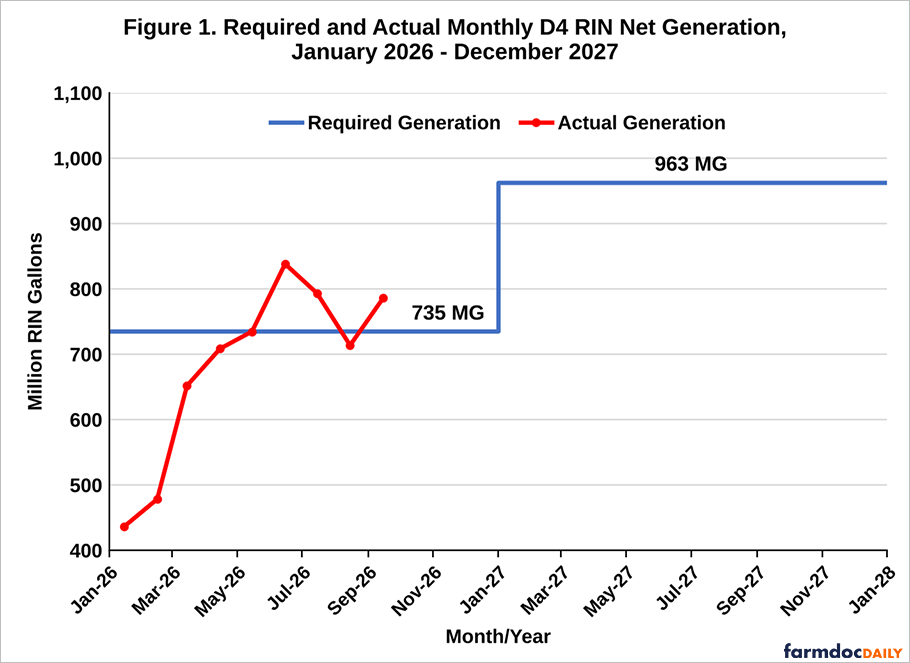
Figure 1 also shows actual monthly D4 net RIN generation through September 2026. Generation started 2026 very weakly, at 436 million RIN gallons in January and 478 million in February. It then recovered steadily: 652 million in March, 709 million in April, 735 million in May, and 838 million in June. The June total was the highest since December 2024. Generation eased to 793 million in July and 714 million in August. It rebounded to 786 million in September.
Monthly generation through September averaged 682 million RIN gallons. That leaves a cumulative shortfall of about 474 million RIN gallons relative to the 735 million pace. To meet the 2026 requirement with only the benchmark deficit, generation must average 893 million RIN gallons per month from October through December. That is well above every month so far in 2026 and just below the record of 906 million set in December 2024. It is also above domestic production capacity, which we discuss below. Still, it is far more attainable than the rest-of-year pace of about 1,090 million we estimated in May. A more likely outcome is a larger deficit. If generation holds at the September level for the rest of the year, the 2026 D4 deficit would be about 0.60 billion RIN gallons. That is 6.7 percent of the biomass-based diesel RVO, more than double the historical average of 3.1 percent. Every additional RIN gallon of the 2026 deficit must be repaid in 2027. A 0.60 billion deficit would raise required generation in 2027 by 0.32 billion, to 11.88 billion or 990 million per month.
The outlook for 2027 is even more challenging. The required pace of 963 million RIN gallons per month is 177 million above the September level. It is also above every monthly total in the historical record, and it must be sustained for all 12 months of the year. Figure 2 adds domestic D4 production capacity, expressed in RIN gallons per month. Domestic capacity is computed by multiplying operable monthly capacity from the EIA by 1.5 for biodiesel and 1.55 for renewable diesel, and summing across the two biofuels. Based on these assumptions, operable capacity is about 878 million RIN gallons per month in 2026 and 2027. So even if every domestic biodiesel and renewable diesel plant ran at 100 percent capacity all year, RIN generation would fall 84 million gallons per month short of the 2027 requirement.
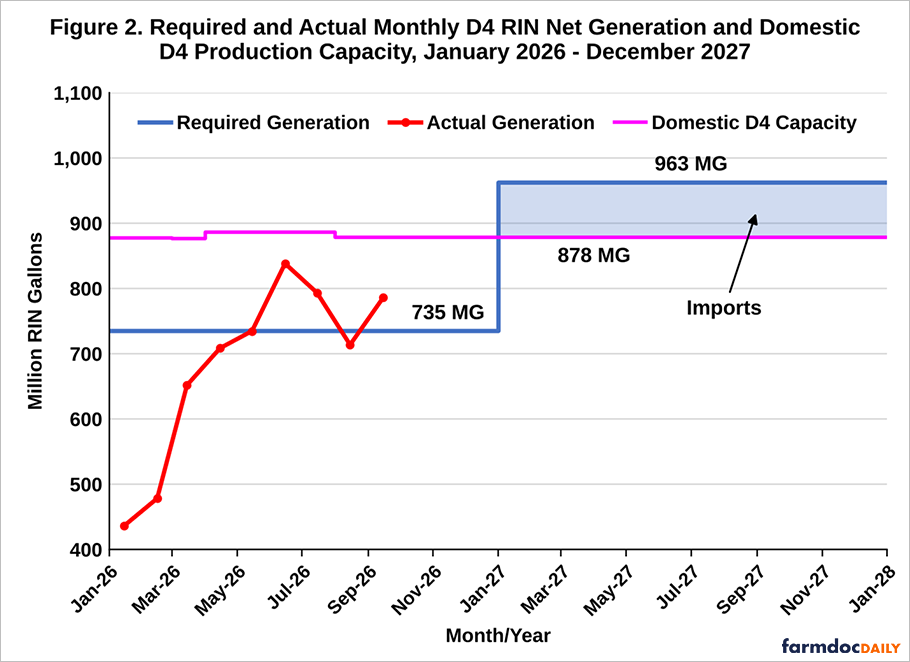
In practice, biodiesel and renewable diesel plants can run above 100 percent of operable capacity, but not for extended periods of time. This means that the gap between full capacity and the D4 RIN requirement in 2027, roughly 1.0 billion RIN gallons for the year, will have to be filled largely by imports. Our balance sheet assumes domestic capacity utilization rises from 60 percent in 2025 to 78 percent in 2026 and 95 percent in 2027. It also assumes imports of biomass-based diesel recover from 0.07 billion gallons in 2026 to 1.08 billion gallons in 2027. That level is not out of reach by historical standards. Imports were 0.86 billion gallons in 2023 and 0.95 billion in 2024, so 2027 imports would need to be only 14 percent above the 2024 level. But conditions have changed. Those imports came before the 45Z credit that went into effect in 2025. Imported fuel does not qualify for the credit, and starting in 2026, the revised credit is limited to fuel made from North American feedstocks. The large imports also came before the disruptions in world energy markets associated with the war with Iran. Imports fell to 0.18 billion gallons in 2025 and have nearly disappeared in 2026. Whether they can return to the 2024 level in 2027 is a key uncertainty.
Our analysis helps frame what is at stake in the coming debates about the 2027 RVOs. Any relief for 2027, whether from a general waiver or another policy change, can lower required D4 generation in two ways. The first is a direct cut to the biomass-based diesel volume. Each RIN gallon cut from the 2027 biomass-based diesel RVO lowers required D4 generation by one RIN gallon. A cut of about 1.01 billion RIN gallons would bring the 2027 requirement down to domestic capacity. A cut of 2.73 billion would hold the 2027 requirement at the 2026 level. The second is a cut to the total renewable fuel volume. That shrinks the conventional gap that D6 ethanol RINs cannot fill. Closing the gap would remove the 1.18 billion RIN gallon D6 pull on D4 RINs in 2027 without touching the biomass-based diesel volume at all. Either way, the size of any relief will decide whether the record 2027 volumes survive.
The outcome obviously matters a great deal for biomass-based diesel producers, who have ramped up production in response to the record RVOs. It also matters to producers of soybean oil and other feedstocks. On average, production of a physical gallon of biomass-based diesel requires about 8 pounds of feedstock. To translate the cuts above into feedstock demand, convert RIN gallons to physical gallons, at the average of about 1.54 RINs per gallon we project for 2027, and multiply by 8. A cut of 1.01 billion RIN gallons equals about 0.66 billion physical gallons of biomass-based diesel and 5 billion pounds of feedstock. A cut of 2.73 billion RIN gallons equals about 1.8 billion physical gallons of biomass-based diesel and 14 billion pounds. It is easy to see that billions of pounds of feedstock demand are at stake in the battle over the 2027 RVOs.
Implications
Our updated balance sheet estimates ease the D4 generation challenge for 2026 but not for 2027. A larger RIN bank and a smaller D6 pull decrease required D4 net generation in 2026 to 8.82 billion RIN gallons, or 735 million per month, with deficits at their historical average. Generation so far has run well short of that pace. Unless the fourth quarter comes close to a record, deficits carried into 2027 will be well above average. The 2027 requirement of 11.55 billion RIN gallons, or 963 million per month, is above anything in the historical record and well above domestic production capacity. A larger 2026 deficit would push it higher still. The RIN bank will be nearly empty in 2027, and the market must count on a large rebound in imports. These numbers set the stage for the coming battle over the 2027 RVOs.
Our balance sheet assumes current policy stays in place. The general waiver petitions this week show how uncertain that is. Compliance costs are at record levels, and refiners have pushed back. The American Fuel & Petrochemical Manufacturers (AFPM) estimate that RFS compliance will cost $106 billion over 2026–2027, or 26 to 35 cents per gallon of gasoline and diesel. The governors of Alabama and Louisiana make a similar case, as they claim the RFS adds significantly to the cost of every gallon of gasoline and diesel sold. They argue that the 2027 standards would cause “severe economic harm” to their states.
The bottom line is that the battle over the 2027 RVOs has begun, and our analysis shows why. EPA’s decisions over the next several months on the waiver petitions, reallocation, and SREs will go a long way toward deciding whether the record-setting 2027 volumes survive. The looming fight over the half-RIN in Set 3 only raises the stakes.
References
Hubbs, T. and S. Irwin. “Rewriting the RFS Playbook: The Impact of Final RVOs on Projected D4 Biomass-Based Diesel RIN Generation for 2026-2027.” farmdoc daily (16):73, Department of Agricultural and Consumer Economics, University of Illinois at Urbana-Champaign, April 27, 2026.
Hubbs, T. and S. Irwin. “Rewriting the RFS Playbook: The Challenge of Meeting D4 Biomass-Based Diesel RIN Generation for 2026-2027.” farmdoc daily (16):82, Department of Agricultural and Consumer Economics, University of Illinois at Urbana-Champaign, May 11, 2026.
Hubbs, T. and S. Irwin. “Rewriting the RFS Playbook: The Impact of Final RVOs on Projected Biomass-Based Diesel Production and Imports for 2026-2027.” farmdoc daily (16):101, Department of Agricultural and Consumer Economics, University of Illinois at Urbana-Champaign, June 10, 2026.
Disclaimer: We request all readers, electronic media and others follow our citation guidelines when re-posting articles from farmdoc daily. Guidelines are available here. The farmdoc daily website falls under University of Illinois copyright and intellectual property rights. For a detailed statement, please see the University of Illinois Copyright Information and Policies here.