








The Unfinished Farm Bill Remains Unfinished and Sends a Warning
The Senate Agriculture, Nutrition, and Forestry Committee appears to have driven another nail in the coffin of the Farm Bill. It remains to be seen if it was the final one. On Thursday, August 6, 2026, the Committee failed to report legislation that committee chairman John Boozman (R-AR) has called “Farm Bill 2.0” (Yarrow, August 6, 2026; Senate ANF, Business Meeting, August 6, 2026; farmdoc daily, July 2, 2026). While Congress has adjourned for the August recess, the Chairman indicated that the committee may try again in the abbreviated and busy month of September (Yarrow and Shin, August 6, 2026; Farm Policy News, August 7, 2026). This failure to report legislation to finish the Farm Bill should send a clear warning, however.
The Food Assistance Roadblock Built by the Reconciliation Farm Bill
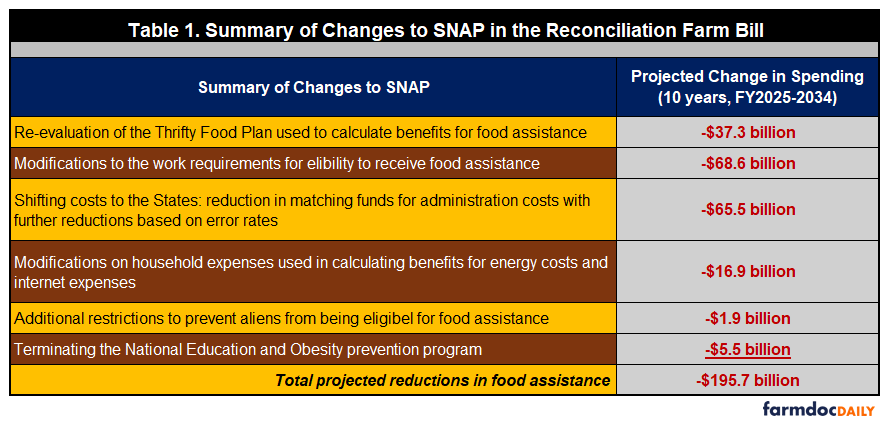
One primary takeaway was clear from the committee markup: the primary roadblock to moving legislation was built by the changes to the Supplemental Nutrition Assistance Program (SNAP) that were included as Title I in the One Big Beautiful Bill (OB3) Act of 2025 and referred to herein as the Reconciliation Farm Bill (Senate ANF, Business Meeting, August 6, 2026; P.L. 119-21). The most significant changes are summarized in Table 1 and include the Congressional Budget Office (CBO) projected changes in spending (CBO, July 21, 2025). In total, CBO projected that the changes would reduce SNAP spending by nearly $200 billion over 10 years (fiscal years 2025 to 2034, excluding interactions).
Previously known as Food Stamps, SNAP helps low-income individuals, families and households purchase of food. In 2025, the program provided an average of $188.33 per person (per month) to more than 42.4 million Americans (on average) each month (USDA-FNS, SNAP Data Tables, “National Level Annual Summary”). One of the political problems for SNAP is that even such a relatively small amount of assistance spends a large amount of federal money when it helps that many people; SNAP benefits totaled over $95.8 billion in 2025, and total program costs exceeded $102.6 billion. When such amounts are estimated in 10-year budget windows, the total costs exceed $1 trillion and too-easily obscure the realities on the ground for those hungry Americans struggling to put food on their tables.
The two largest changes summarized in Table 1 are designed to increase paperwork requirements and bureaucratic burdens, or barriers, to those seeking food assistance. They reduce spending by pushing people out of the program or preventing them from being able to sign-up for benefits. Recent reporting on the experiences of people in Arizona should be raising alarm bells about these changes (Kitroeff and DeParle, August 5, 2026; Kim, August 3, 2026; DeParle and Zehbrauskas, July 20, 2026; Cruz, June 17, 2026; Brangham and Merchant, June 8, 2026; Qiu, April 26, 2026; Cruz, April 8, 2026; Rosenbaum et al., August 5, 2026). Those experiences are likely the tip of this iceberg, demonstrating what is likely to happen in other states as these changes are implemented and the impacts hit home.
The Chairman’s draft included a one-year delay in the implementation of the State cost-share changes (Senate ANF, “Farm Bill 2.0” at Sec. 4101). The offer of a delay could be a tacit acknowledgement of the problems created by the Reconciliation Farm Bill. It was not enough, however, to bring any support from the Democrats on the committee. This may serve as a preview of a more troubled future.
An Uncomfortable Juxtaposition with Farm Assistance
There wasn’t much traditional farm in this farm bill, attempts at political branding notwithstanding. The committee markup, like the legislative draft being considered, contained little of substance on farm policy because those priorities—notably the increases to reference prices, additional base acres, and expansion of crop insurance—were taken care of in the Reconciliation Farm Bill. Potential amendments requiring an update to base acres must have set off a different set of alarm bells, however (Parum, August 5, 2026). No such amendment was debated or considered during the markup. The prominent warning may have exposed more about the troubled state of farm policy than likely intended.
The combination of base acres and fixed reference price thresholds for payments plagues farm policy and is likely to get worse. Farmers can plant program crops that differ from base acres without impacting payments; unequal or unbalanced payments among different program crop base acres—a result of Congressional decisions on fixed reference prices and inaction on base acres—result in some farmers receiving more for the same crops because of policy (farmdoc daily, January 15, 2026; January 22, 2026; January 29, 2026; February 12, 2026; February 16, 2026). The issue remains obscure, however, and easily passed over when attention is focused on SNAP.
Table 2 may provide an initial decoder to the mandatory base acre update issue with a summary comparison of the national level data on acres and prices. Table 2 does not include the 30 million additional base acres provided by the Reconciliation Farm Bill because those have not been allocated by FSA as of this writing. No CBO score has been reported for a mandatory base acre update. The only public estimate thus far is that an update could cost farmers $18 billion over 9 years (Parum, August 5, 2026). This estimate could not be confirmed or replicated using existing FSA data and additional analysis is underway.
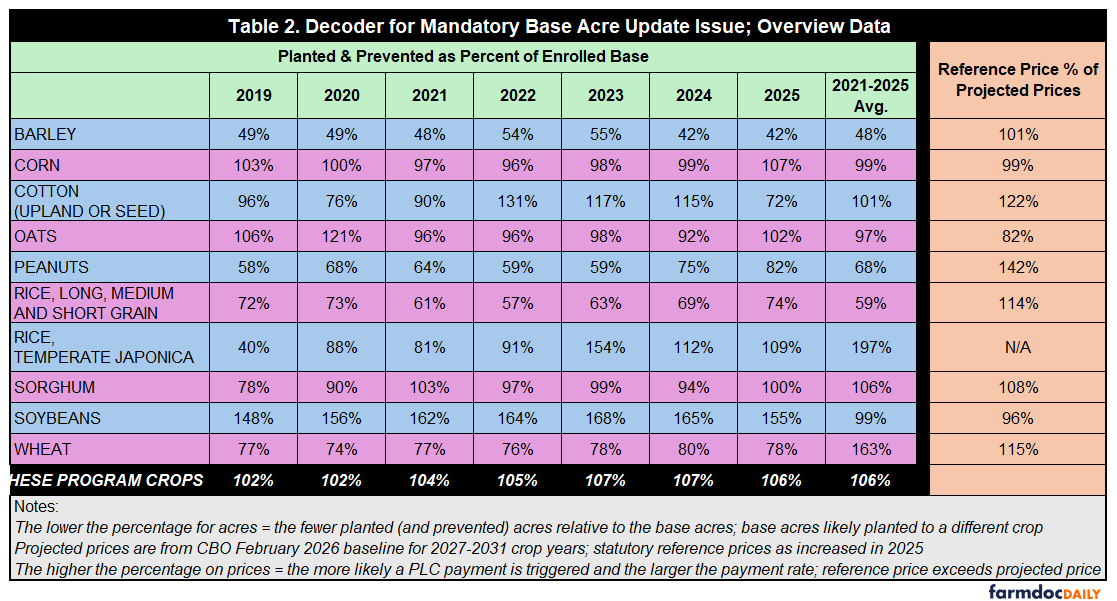
The percentages offer an initial way to decode the base acre update issue. For base acres, higher percentages indicate more planted acres than base acres in the year. Lower percentages indicate crops that were underplanted relative to base acres and those base acres were likely planted to a different program crop. The average from 2021 to 2025 provides the same point for the years likely to be used for a mandatory update. Finally, the last column adds a comparison of the statutory reference prices, as increased in the Reconciliation Farm Bill, to an average of CBO’s most recent price projections for the 2027-2031 crop years (CBO, February 2026 Baseline). The higher the percentage in this column, the more likely a PLC payment would be triggered and the higher the expected payment rate.
The combination of a lower acreage percentage and higher reference price percentage is an indication that farmers with those base acres would see them shift to other crops, potentially those with a lower likelihood of PLC payments or smaller payment rates. These are the political issues at play here, causing the existing divisions within row-crop agriculture that was made worse by the Reconciliation Farm Bill. Once again, the attention on SNAP also conveniently served to hide such problems in farm policy (farmdoc daily, July 17, 2025; July 31, 2025; August 14, 2025; August 21, 2025; August 28, 2025; September 4, 2025). The juxtaposition with farm support policy could become increasingly uncomfortable, however, given that the costs of these changes to farm policy were offset by the additional bureaucratic barriers and paperwork requirements for food assistance.
Concluding Thoughts
Ginning up concern about a mandatory base acre update should expose the rot at the core of the Farm Bill and budget policy, as well as their troubled linkages. Congress cannot bring itself to correct obvious problems in farm policy that would also reduce federal spending—something as minor as shifting some of the base acres around to better reflect modern planting patterns. Even if the change scores $18 billion in savings over 9 years, it is a fraction of the nearly $68 billion in additional spending on farm assistance, or the total baseline of farm payments that now exceeds $115 billion over the next 10 years. Two billion dollars less in annual payments also pales in comparison to the $9 billion in ECAP payments made last year, the $10 billion in “bridge” payments already made this year (FSA, ECAP Dashboard; USDA, FBA Dashboard), and another $12 billion Congress is seeking to send to farmers with an unprecedented third reconciliation bill (H. Con. Res. 113; Senate Budget Committee, August 8, 2026; S. Con. Res.). Ironically, this additional $31 billion in ad hoc money flowing to farmers will be made on planted acres, not base acres.
Irony gives way to tragedy when this largesse is juxtaposed with what is unfolding in food assistance for the tens of millions of Americans struggling to put food on the table and partake of the vast abundance of American agriculture. Big budget numbers and selective hawkishness on federal spending conveniently obscure such matters, focusing too much attention on clever methods to reduce baseline spending and ignoring the impacts on people at the other end of these policy and scoring maneuvers. But that has become the political game of budget policy as it has mutated over time (farmdoc daily, March 13, 2025; June 18, 2025). As of this writing, the national debt is approaching $40 trillion and CBO projects deficits each fiscal year that range from $1.8 trillion to over $3 trillion (Treasury.gov, “What is the national debt?”; CBO, February 2026). These realities obliterate any justifications for this policy’s continued existence
What budget policy has not achieved for the budget is made much worse by how it has drastically warped Congressional political power dynamics and damaged the legislative process. Whatever theory of competition among factional interests that may have been intended in the design of Congress has been buried by the budget. Smaller, more concentrated and sophisticated factions have asymmetrical political power; it is easier for them to achieve their narrow self-interests, in party by providing them without outsized negotiating leverage (farmdoc daily, January 12, 2023; January 26, 2023). When policymakers focus on large baseline spending by programs that provide small benefits to large constituencies, they end up increasing further the power of smaller factions. The Farm Bill has long demonstrated this; budget reconciliation has given small factional interests even more powerful options, as evidenced by the Reconciliation Farm Bill.
What is happening to people in Arizona is a loud, clear warning siren. Fixing the problems will only get more expensive. As they do, the barriers for this and any future Farm Bill grow exponentially. For those truly concerned about these policies and the people they are intended to help, the best path forward to repair the damage is likely the most difficult: reverse and unwind the Reconciliation Farm Bill changes, all of them, and start over. Any reconciliation bill Congress considers in September offers an opportunity to start. While farm policy certainly needs new thinking and significant improvements, supporters should realize that the changes to SNAP are nothing more than bureaucratic barriers to assistance. Paperwork requirements will do little to fix anything. Most importantly, additional bureaucratic burdens will not solve the very real hunger problems that too many face; they will not create jobs that do not exist, nor offer jobs that pay enough to live on (GAO-26-108703, June 22, 2026). Everyone can relate to the infuriation and frustration of bureaucratic paperwork. Not all of us have to wrestle with it, however, while being hungry, or worse, holding the hand of a hungry kid.
References
Brangham, William and Azhar Merchant. “Millions lose SNAP benefits as One Big Beautiful Bill’s stricter requirements kick in.” PBS.org. June 8, 2026. https://www.pbs.org/newshour/show/millions-lose-snap-benefits-as-one-big-beautiful-bills-stricter-requirements-kick-in.
Congressional Budget Office. “Estimated Budgetary Effects of Public Law 119-21, to Provide for Reconciliation Pursuant to Title II of H. Con. Res. 14, Relative to the Budget Enforcement Baseline for Consideration in the Senate.” Cost Estimate. July 21, 2025. https://www.cbo.gov/publication/61569.
Congressional Budget Office. “10-Year Budget Projections.” February 2026. https://www.cbo.gov/system/files/2026-02/51118-2026-02-Budget-Projections.xlsx.
Congressional Budget Office. “Baseline Projections: USDA Farm Programs.” February 2026. https://www.cbo.gov/system/files/2026-01/51317-2026-02-usda.xlsx.
Coppess, J. "On the Origins of Budget Reconciliation." farmdoc daily (15):48, Department of Agricultural and Consumer Economics, University of Illinois at Urbana-Champaign, March 13, 2025.
Coppess, J. "Farm Bill in Reconciliation: What the Byrd Rule Exposes but Does Not Resolve." farmdoc daily (15):112, Department of Agricultural and Consumer Economics, University of Illinois at Urbana-Champaign, June 18, 2025.
Coppess, J. "The Farm Bill in Reconciliation: Loophole as Rosetta Stone; Review and Comment." farmdoc daily (15):130, Department of Agricultural and Consumer Economics, University of Illinois at Urbana-Champaign, July 17, 2025.
Coppess, J. "The Reconciliation Farm Bill: The Top Five Most Problematic Changes to Farm Policy, #5." farmdoc daily (15):139, Department of Agricultural and Consumer Economics, University of Illinois at Urbana-Champaign, July 31, 2025.
Coppess, J. "The Reconciliation Farm Bill: Top Five Most Problematic Changes to Farm Policy, #4." farmdoc daily (15):147, Department of Agricultural and Consumer Economics, University of Illinois at Urbana-Champaign, August 14, 2025.
Coppess, J. "The Reconciliation Farm Bill: Top Five Most Problematic Changes to Farm Policy, #3." farmdoc daily (15):152, Department of Agricultural and Consumer Economics, University of Illinois at Urbana-Champaign, August 21, 2025.
Coppess, J. "The Reconciliation Farm Bill: Top Five Most Problematic Changes to Farm Policy, #2." farmdoc daily (15):157, Department of Agricultural and Consumer Economics, University of Illinois at Urbana-Champaign, August 28, 2025.
Coppess, J. "The Reconciliation Farm Bill: Top Five Most Problematic Changes to Farm Policy, #1." farmdoc daily (15):161, Department of Agricultural and Consumer Economics, University of Illinois at Urbana-Champaign, September 4, 2025.
Coppess, J. "Considering Congress, Part 4: The Double Majority." farmdoc daily (13):6, Department of Agricultural and Consumer Economics, University of Illinois at Urbana-Champaign, January 12, 2023.
Coppess, J. "Considering Congress, Part 5: An Initial Critique of the Design." farmdoc daily (13):15, Department of Agricultural and Consumer Economics, University of Illinois at Urbana-Champaign, January 26, 2023.
Coppess, J. "The Unfinished Farm Bill: First Reading of Proposed Senate Legislation." farmdoc daily (16):116, Department of Agricultural and Consumer Economics, University of Illinois at Urbana-Champaign, July 2, 2026.
Coppess, J. "Off Base, Part 1: Reviewing Issues and Problems with Base Acre Policy." farmdoc daily (16):7, Department of Agricultural and Consumer Economics, University of Illinois at Urbana-Champaign, January 15, 2026.
Coppess, J. "Off Base, Part 2: The View from the CBO Baseline." farmdoc daily (16):10, Department of Agricultural and Consumer Economics, University of Illinois at Urbana-Champaign, January 22, 2026.
Coppess, J. "Off-Base, Part 3: Picking Winners & Losers with Policy." farmdoc daily (16):13, Department of Agricultural and Consumer Economics, University of Illinois at Urbana-Champaign, January 29, 2026.
Coppess, J. "Off-Base, Part 4: A Fundamental Flaw in the Policy." farmdoc daily (16):22, Department of Agricultural and Consumer Economics, University of Illinois at Urbana-Champaign, February 12, 2026.
Coppess, J. "Off-Base, Part 5: Farm Policy Has Been Here Before; Lessons Reinforced by History." farmdoc daily (16):24, Department of Agricultural and Consumer Economics, University of Illinois at Urbana-Champaign, February 16, 2026.
Cruz, Nicole Santa. “More Than 770,000 Children Are No Longer Receiving SNAP Benefits After Trump Changes Federal Food Program.” ProPublica.org. June 17, 2026. https://www.propublica.org/article/snap-benefits-children-food-stamps.
Cruz, Nicole Santa. “’The Alarm Bell’: Arizona’s Drop in SNAP Participation Signals Potential Nationwide Impact of Trump Legislation.” ProPublica. April 8, 2026. https://www.propublica.org/article/arizona-snap-benefits-trump-legislation.
DeParle, Jason and Adriana Zehbrauskas. “Faced With Piles of New Paperwork, People Are Losing Food Stamps.” The New York Times. July 20, 2026. https://www.nytimes.com/2026/07/20/us/politics/snap-food-stamps-arizona.html.
Hanrahan, Ryan. “Senate Farm Bill Fails, Ag Committee to Vote Again in September.” Farm Policy News. August 7, 2026. https://farmpolicynews.illinois.edu/2026/08/senate-farm-bill-fails-ag-committee-to-vote-again-in-september/.
Kim, Juliana. “Over 4 million people are no longer receiving food aid amid sweep changes to SNAP.” NPR.org. August 3, 2026. https://www.npr.org/2026/08/03/nx-s1-5906797/snap-food-stamp-federal-changes-what-to-know.
Kitreoff, Natalie and Jason DeParle. “Arizona’s Food Stamp Crisis Is Coming for the Rest of the U.S.” The Daily, The New York Times. August 5, 2026. https://www.nytimes.com/2026/08/05/podcasts/the-daily/arizona-food-stamp-snap.html.
Parum, Faith. “Mandatory Base Acre Update Would Hurt Farmers.” American Farm Bureau Federation, Market Intelligence. August 5, 2026. https://www.fb.org/intel/markets/mandatory-base-acre-update-would-hurt-farmers.
Qiu, Linda. “The Trump Administration Has Changed Almost Every Aspect of Food Stamps.” The New York Times. April 26, 2026. https://www.nytimes.com/2026/04/26/us/trump-administration-food-stamps.html.
Rosenbaum, Dottie, Joseph Llobrera, Catlin Nchako, and Luis Nunez. “SNAP Tracker: People Are Losing Food Assistance as the Harmful 2025 Republican Reconciliation Law Is Implemented.” Center on Budget and Policy Priorities. August 5, 2026. https://www.cbpp.org/research/food-assistance/snap-tracker-people-are-losing-food-assistance-as-the-republican-megabill.
U.S. Government Accountability Office. “Federal Safety Net Programs: Millions of Workers, Including Many Employed by Large Employers, Continue to Rely on Medicaid and SNAP.” GAO-26.108703. June 22, 2026. https://www.gao.gov/products/gao-26-108703.
Yarrow, Grace. “Senate Republicans’ farm bill fails over SNAP stalemate.” Politico.com. August 6, 2026. https://www.politico.com/live-updates/2026/08/06/congress/snap-stalemate-scuttles-senate-republicans-farm-bill-01027439.
Yarrow, Grace and Rachel Shin. “Boozman to reconvene farm bill markup after failed vote.” Politico.com. August 6, 2026. https://www.politico.com/live-updates/2026/08/06/congress/boozman-to-reconvene-farm-bill-markup-after-failed-vote-01027582.
Disclaimer: We request all readers, electronic media and others follow our citation guidelines when re-posting articles from farmdoc daily. Guidelines are available here. The farmdoc daily website falls under University of Illinois copyright and intellectual property rights. For a detailed statement, please see the University of Illinois Copyright Information and Policies here.