








The Unfinished Farm Bill: First Reading of Proposed Senate Legislation
On June 23, 2026, Senator John Boozman (R-AR), chairman of the Senate Committee on Agriculture, Nutrition, and Forestry (ANF), released legislative text for the unfinished provisions of the traditional Farm Bill. Chairman Boozman is calling the legislation “Farm Bill 2.0” (Senate ANF, “Farm Bill 2.0” and Press Release, June 23, 2026). This article provides a first reading of the legislative text and some discussion about cuts to conservation proposed in it.
Background
The legislation being considered in Congress for food and agricultural policy is effectively the unfinished business of the traditional Farm Bill (Monke and Stubbs, December 18, 2025; farmdoc daily, April 30, 2026). The 119th Congress broke apart the traditional Farm Bill last year with the Reconciliation Farm Bill included in the One Big Beautiful Bill (OB3) Act of 2025 (P.L. 119-21). In that legislation, Congress cut food assistance in the Supplemental Nutrition Assistance Program (SNAP) by nearly $200 billion over ten fiscal years with a portion of those reductions used to offset the costs of substantially increasing support for farmers (CBO, July 21, 2025). With this, Congress broke the cardinal political rule of the traditional Farm Bill—i.e., that spending cuts for food assistance should not be used to fund spending increases for farm assistance and vice versa. The Reconciliation Farm Bill also left behind all other titles and programs, including the Conservation Reserve Program (CRP). Congress has not reauthorized the bulk of the traditional Farm Bill, including every program for rural economic development, research, many trade and food aid programs, forestry, energy, and the CRP. It is this unfinished Farm Bill business that Congress is now trying to address, belatedly and in the shortened legislative calendar of a difficult midterm election year. The House passed its version on April 30, 2026 (H.R. 7567; House.gov, April 29, 2026).
Chairman Boozman’s draft constitutes the first step in the Senate. the legislation will struggle to make it through the difficult legislative process within the campaign-shortened legislative calendar (including the August recess), and may require a lame duck session of Congress to complete as in 2018 (farmdoc daily, December 12, 2018). While Chairman Boozman’s draft is a critical first step, it should also be noted that it is long overdue. To recap, the 2018 Farm Bill technically expired in 2023, but the 118th Congress did not act. In 2024, the House Agriculture Committee reported reauthorization legislation that was not considered on the House floor. The Senate ANF Committee did not consider Farm Bill legislation in either year, former Chairman Debbie Stabenow (D-MI) and then ranking member Senator Boozman released competing Farm Bill texts after the election. The committee also did not formally markup legislation for the Reconciliation Farm Bill that was added to OB3 in 2025. If the Senate ANF Committee marks up the legislation recently introduced, it will be the first such formal debate of legislation since 2018 (Bridges, November 18, 2024; Baethge, November 18, 2024; Farm Policy News, November 19, 2024; Monke, December 26, 2024; see also, farmdoc daily, June 18, 2025; May 30, 2024; June 6, 2024; September 12, 2024; November 21, 2024).
Discussion
Chairman Boozman’s discussion draft weighs in at 902 pages. A first reading reveals that it is a mostly typical reauthorization of all the programs not included in the Reconciliation Farm Bill, such as those for rural development and research. For example, the very first section extends the suspension of permanent price support authority in the 1949 Agricultural Act to 2031. There are myriad changes to programs throughout the titles that appear to be standard and likely uncontroversial. This conclusion awaits a closer read and the public deliberation a markup provides.
There is one rather puzzling exception, however. In the conservation title, Chairman Boozman’s draft includes a nearly $2 billion cut to the Environmental Quality Incentives Program (EQIP). While a CBO score was not available as of this writing, it is presumed that at least some of that reduction is used to offset the costs of other changes to conservation programs, including a new program, the Forest Conservation Easement Program. There are multiple reasons this raises concerns and may spark controversy.
Cutting EQIP funding breaks the commitment to the program made in the Reconciliation Farm Bill last year; Congress rescinded the additional funds it had provided to EQIP in the Inflation Reduction Act of 2022, adding them to the longer-term baseline budget authority. This was essentially a trade-off for conservation investments for farmers, trading the short-term increase of the Inflation Reduction Act for the long-term budget authority in the CBO baseline (farmdoc daily, September 11, 2025; August 15, 2024; October 10, 2024). For that trade-off to benefit farmers, Congress would have to avoid cutting the budget authority in the future. It now appears that both the Senate ANF Committee and the House Agriculture Committee are willing to go back on the earlier deal. Doing so also opens the door to further cuts to conservation by this or a future Congress. Table 1 details proposed cuts at issue, comparing the baseline budget authority with the Senate ANF revisions and the revisions that passed the House.
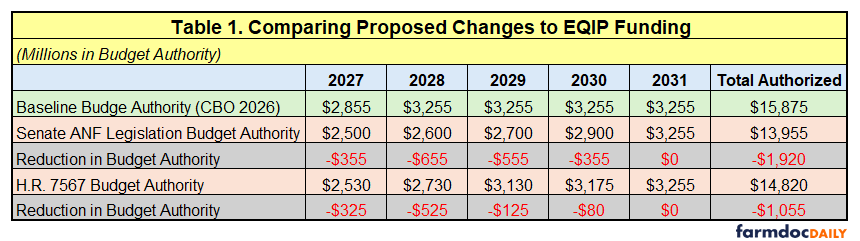
Not only do both bills cut EQIP budget authority, but both sets of reductions are front loaded in fiscal years 2027 through 2030, returning to the baseline level in FY2031. This preserves the baseline funding in the outyears of a 10-year CBO projection, but it forces the entire reduction in the next couple of years impacting farmers sooner rather than later.
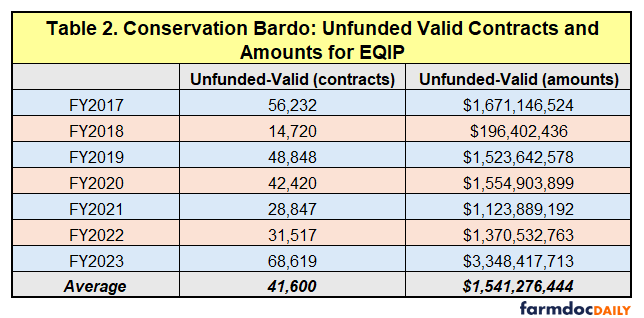
The proposed cuts also highlight existing challenges for EQIP that will be made worse by reduced funding. The program remains oversubscribed with more farmers seeking funding than Congress makes available. EQIP, in fact, has consistently experienced a backlog of farmer applications that are approved for funding but not funded (valid unfunded contracts) because Congress has authorized too little for the demand for assistance from farmers (farmdoc daily, September 28, 2023). Based on data reported by USDA, EQIP has averaged 41,600 and over $1.5 billion in unfunded valid contracts in recent years (FY 2017 to FY 2023) (USDA-OBPA, “Congressional Justifications” as reported for FY 2019 to FY2025). Table 2 summarizes the USDA data for this conservation bardo of EQIP unfunded valid contracts and amounts.
Each unfunded valid contract represents a farmer seeking assistance from EQIP to implement conservation practices on their farm. This on-the-ground, fundamental reality is too easily lost in the inside-the-beltway efforts to game the CBO scoring system. To better understand the real-world impact, Figure 1 provides an interactive map of the estimated consequences for cutting EQIP funding by State. In total, the proposed reductions to EQIP funding in the Senate bill could result in over 56,500 valid farmer applications to go without funding in the next few fiscal years.
The state-by-state estimates for potential lost funding were calculated using historic allocations of EQIP funds, as reported by USDA and visualized by the Policy Design Lab (Policy Design Lab, “EQIP”). Those lost funds were divided by the average amount per unfunded valid contract for each State in the USDA data used for Table 2. For example, if the cuts to EQIP funding were enacted into law as proposed in the Senate legislative text, Illinois could lose nearly $27 million in EQIP funding in the next few years, equal to 755 more valid but unfunded contracts with farmers.
Concluding Thoughts
A Farm Bill 2.0 is necessary only because Congress did not reauthorize the Farm Bill in 2023. Congress chose instead to pay for increased payments to farmers with cuts to food assistance in SNAP and used the budget reconciliation process that left much of the traditional Farm Bill as unfinished business. While much of the proposed legislative text in the Senate appears to be uncontroversial, it cannot be divorced from this recent history. The controversies ignited by the Reconciliation Farm Bill complicate the enactment of the remaining authorizations and cast substantial doubt on the future of the traditional Farm Bill.
Adding further concern are the proposed cuts to conservation assistance. The Senate proposal would cut the Environmental Quality Incentives Program (EQIP) by nearly $2 billion over the next four fiscal years. This proposed cut breaks the commitment to conservation in the Reconciliation Farm Bill, which eliminated additional funding for conservation provided in the Inflation Reduction Act for the promise of increased baseline funding over the long-term life of the program. More importantly, fewer funds available mean that fewer farmers will get assistance for implementing conservation on their farms, efforts that are costly, risky, and complicated but provide benefits to the farmer as well as to society in the form of less erosion, cleaner water, and more. Cutting this funding means more farmers will be approved for assistance but not be able to receive it. It will increase the conservation bardo plaguing those farmers who seek conservation assistance, increasing frustration with the policies, programs and agencies.
The Senate proposal adds yet more difficult questions to a troubled history for agricultural conservation policy. Despite demand from farmers and broad support among the taxpaying public, Congress has historically treated conservation as a secondary priority or worse. These programs are consistently cut, capped, and constrained in ways that hurt farmers and everyone who relies on the natural resources necessary for farming. Congress does so, moreover, in ways that are unique to conservation policy. Neither farm subsidy payments nor crop insurance have ever been burdened in the same way. These issues are not new (Coppess, 2024). The changes from the Inflation Reduction Act of 2022 to the Reconciliation Farm Bill in 2025, and now the proposed legislation for addressing the unfinished Farm Bill, expose clearly the extent of this problem for public policy like conservation.
After the brief boost in conservation investments by the Inflation Reduction Act, conservation policy has been forced to play a zero-sum game, cannibalizing its existing funding to cover any new conservation investments or policies. Farm payments and crop insurance, however, have not been forced to play by this zero-sum game, nor have they been constrained by budget rules. When Congress wants to boost spending on these programs, it is willing to go so far as violating the cardinal political rule of Farm Bills and cut food assistance for low-income households to cover the costs; if that takes too long or is insufficient, Congress and/or USDA simply pile on more payments through ad hoc and supplemental payments that are exempted from budget rules. Consider that since 2018, conservation assistance has totaled $37 billion and ARC/PLC payments $35 billion, while net crop insurance benefits have been $38.5 billion. Over those same years, $110 billion has been paid out in ad hoc and supplemental assistance to farmers. And, while the Reconciliation Farm Bill was projected to pay farmers an additional $61 billion, with another $5 billion for crop insurance, the conservation programs were projected to lose $1.8 billion. The conservation questions contained in these Congressional funding decisions pile up with the payments.
References
Baethge, Joshua. “Stabenow releases Senate farm bill proposal.” Farmprogress.com November 18, 2024. https://www.farmprogress.com/farm-policy/stabenow-releases-senate-farm-bill-proposal.
Bridges, Olivia M. “Senate farm bill differs from House on CCC, food stamp benefits.” Roll Call. November 18, 2024. https://rollcall.com/2024/11/18/senate-farm-bill-differs-from-house-on-ccc-food-stamp-benefits/.
Congressional Budget Office. “Estimated Budgetary Effects of Public Law 119-21, to Provide for Reconciliation Pursuant to Title II of H. Con. Res. 14, Relative to CBO’s January 2025 Baseline.” Cost Estimate. July 21, 2025. https://www.cbo.gov/publication/61570.
Coppess, Jonathan. Between Soil & Society: Legislative History and Political Development of Farm Bill Conservation Policy (University of Nebraska Press, 2024). https://www.nebraskapress.unl.edu/nebraska/9781496225146/between-soil-and-society/.
Coppess, J. "Chemical Collision: The Pesticide Provisions that Nearly Derailed the House Bill." farmdoc daily (16):76, Department of Agricultural and Consumer Economics, University of Illinois at Urbana-Champaign, April 30, 2026.
Coppess, J. "The Reconciliation Farm Bill: Is Conservation a Silver Lining?" farmdoc daily (15):166, Department of Agricultural and Consumer Economics, University of Illinois at Urbana-Champaign, September 11, 2025.
Coppess, J. "The Reconciliation Farm Bill: Top Five Most Problematic Changes to Farm Policy, #1." farmdoc daily (15):161, Department of Agricultural and Consumer Economics, University of Illinois at Urbana-Champaign, September 4, 2025.
Coppess, J. "Farm Bill in Reconciliation: What the Byrd Rule Exposes but Does Not Resolve." farmdoc daily (15):112, Department of Agricultural and Consumer Economics, University of Illinois at Urbana-Champaign, June 18, 2025.
Coppess, J. and Y. Peng. "Conservation Tradeoff: EQIP in the Inflation Reduction Act and the House Farm Bill." farmdoc daily (14):185, Department of Agricultural and Consumer Economics, University of Illinois at Urbana-Champaign, October 10, 2024.
Coppess, J. "The Unfortunately Obligatory Farm Bill Expiration and Extension Discussion." farmdoc daily (14):166, Department of Agricultural and Consumer Economics, University of Illinois at Urbana-Champaign, September 12, 2024.
Coppess, J. "Conservation Tradeoff: Inflation Reduction Act vs. Baseline." farmdoc daily (14):150, Department of Agricultural and Consumer Economics, University of Illinois at Urbana-Champaign, August 15, 2024.
Coppess, J. "Budgetary Dissonance and the 2024 House Farm Bill." farmdoc daily (14):106, Department of Agricultural and Consumer Economics, University of Illinois at Urbana-Champaign, June 6, 2024.
Coppess, J. "Farm Bill 2023: NRCS Backlogs and the Conservation Bardo." farmdoc daily (13):177, Department of Agricultural and Consumer Economics, University of Illinois at Urbana-Champaign, September 28, 2023.
Coppess, J., G. Schnitkey, C. Zulauf, N. Paulson, B. Gramig and K. Swanson. "The Agriculture Improvement Act of 2018: Initial Review." farmdoc daily (8):227, Department of Agricultural and Consumer Economics, University of Illinois at Urbana-Champaign, December 12, 2018.
Monke, Jim. “Farm Bills: Major Legislative Actions, 1965-2024.” Congressional Research Service. R45210. December 26, 2024. https://www.congress.gov/crs-product/R45210.
Monke, Jim and Megan Stubbs. “The Farm Bill After FY2025 Budget Reconciliation: Frequently Asked Questions.” Congressional Research Service. R48775. December 18, 2025. https://www.congress.gov/crs-product/R48775.
Disclaimer: We request all readers, electronic media and others follow our citation guidelines when re-posting articles from farmdoc daily. Guidelines are available here. The farmdoc daily website falls under University of Illinois copyright and intellectual property rights. For a detailed statement, please see the University of Illinois Copyright Information and Policies here.